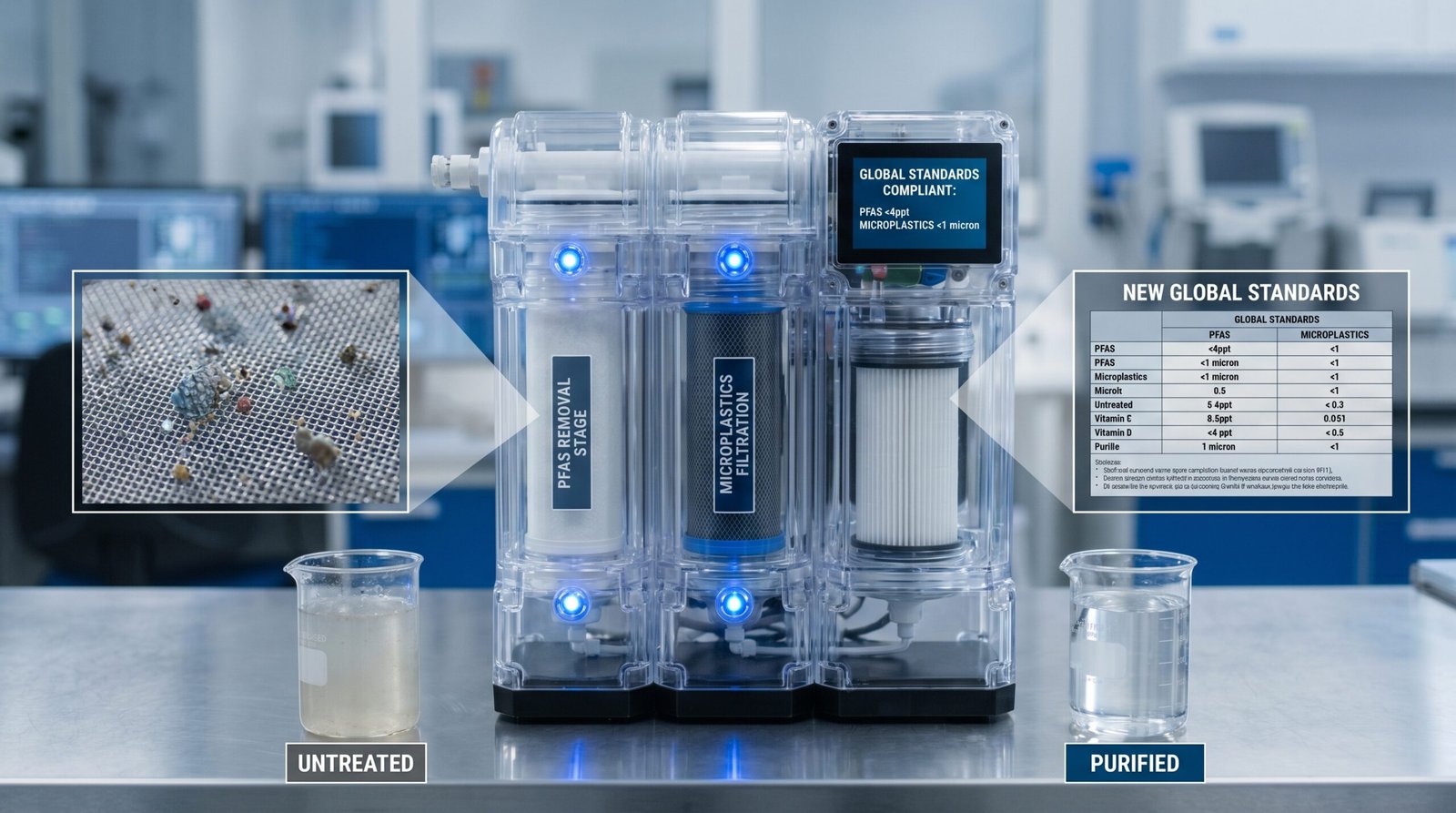
I know the pressure of meeting strict new EU and US water regulations. I have seen premium brands lose market share because their OEM couldn’t prove contaminant removal.
Evaluating your water purifier OEM for PFAS and microplastics requires verifying NSF/ANSI 53 or 58 certifications and auditing their laboratory testing data. A top-tier partner must offer high-density carbon block technology and documented batch traceability to ensure consistent safety and compliance across global markets.
Building a reliable supply chain is about more than just buying a machine; it is about finding a partner who understands that your brand’s reputation depends on every single drop.
Advanced Filtration Technologies: Meeting NSF/WQA Standards for Emerging Contaminant Removal?
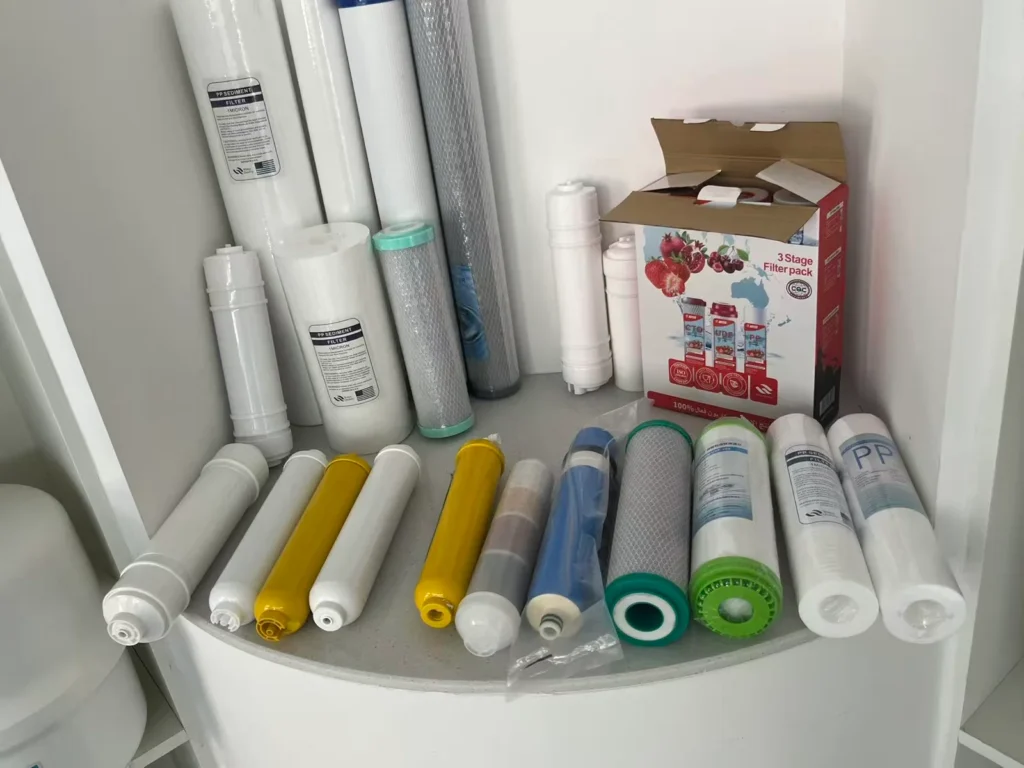
I remember a client who almost faced a massive recall because their previous supplier used low-quality carbon. I helped them rebuild their entire filter line using high-density blocks.
Meeting new global standards for PFAS and microplastics requires an OEM to provide verified Lab Testing Data and hold certifications like NSF/ANSI 53 or 58. Advanced partners use precise pore size control and high-iodine GAC quality to ensure these “forever chemicals” are effectively trapped and removed.
The Science of Pore Size Control
Microplastics are everywhere, but they are not invisible to the right technology. To stop these particles, your manufacturer must master pore size control. We use a multi-stage approach. First, we use physical barriers to stop large particles. Then, we use specialized sub-micron membranes. These membranes act like a high-tech wall. They allow water to pass but keep the plastic out. If your OEM cannot show you the micron rating of their filters, they are not ready for the modern market.
Mastering Carbon Block Density
PFAS removal is much harder than removing chlorine. It requires a very high carbon block density. We source premium coconut shell activated carbon with a high iodine value. This creates more “sticky” surface area inside the filter. When water flows through, the PFAS molecules are pulled out and held tight. Cheap factories use loose carbon that lets these chemicals slip through. You must ask for the specific density specs of the carbon blocks used in your OEM products.
Performance Comparison Table
| Performance Metric | Standard OEM Filter | High-End DEWIN ODM | Verification Method |
| PFAS/PFOA Removal | < 80% (Inconsistent) | > 98% (Certified) | NSF/ANSI 53 Lab Report |
| Microplastic Trapping | > 5 Microns | < 0.5 Microns | Third-Party Particle Test |
| GAC Iodine Value | 600 – 800 mg/g | 1000 – 1100 mg/g | Incoming Material Audit |
| Pore Size Control | Manual/Variable | Automated/Constant | Scanning Electron Microscope |
Evidence-Based Sourcing
Alex, you know that a “promise” is not a “proof.” We provide our B2B partners with full laboratory testing data. We do not just say our filters work; we show the reduction numbers from independent labs. This data is the bridge that allows your brand to enter the German or US markets with total confidence. When you sell a premium system, you are selling the data behind the filter.
Flawless Quality Control: How Factory Standards Prevent Media Fluctuations?

I once audited a factory where the filters changed quality every month. This “media fluctuation” is a nightmare for big brands. I solved this by implementing automated dosing systems.
Flawless quality control prevents media fluctuations by using automated raw material dosing and real-time online detection equipment. Leading manufacturers offer full batch traceability, allowing sourcing directors to track every filter back to its original raw material lot and specific production time.
Eliminating Human Error in Media Mixing
The biggest risk in filter production is the human factor. If a worker adds too much or too little binder to the carbon mix, the filter fails. We use a fully automated dosing system. Computers measure the exact weight of every ingredient. This ensures that the first filter we make today is exactly the same as the ten-thousandth filter we make next month. For a brand like yours, consistency is the foundation of quality.
Real-Time Online Detection
We do not wait until the end of the day to check for mistakes. Our production lines use online detection equipment. These sensors check for air leaks and flow rates in real-time. If a single unit does not meet the standard, the machine removes it from the line automatically. This “zero-defect” goal is how we help our partners maintain extremely low return rates in expensive Western markets.
The Power of Batch Traceability
What happens if a customer has a problem one year from now? With our batch traceability system, we can find the answer in minutes. Every filter has a laser-etched code. This code tells us which batch of carbon was used and which machine assembled it.
| QC Requirement | Traditional Factory | DEWIN Professional OEM | Brand Benefit |
| Media Mixing | Manual shoveling | Automated computer dosing | Consistent filtration life |
| Leak Testing | Manual water dip | Automated high-pressure air | Zero “wet box” damage |
| Traceability | None or Paper logs | Digital Laser QR Coding | Rapid recall protection |
| Workshop Environment | Standard warehouse | Class 100,000 Cleanroom | No internal contamination |
Professional Laboratory Support
Our factory is your laboratory. We maintain in-house NSF-standard testing equipment. We perform life-cycle tests on every new batch of media. We simulate years of use in just a few weeks. This rigorous testing ensures that when you put your logo on our product, it will perform perfectly for the end-user. You are not just buying a filter; you are buying an insurance policy for your brand’s integrity.
Co-Developing Exclusive Molds: Turning Minimalist Aesthetics into Scalable Products?

I see too many “copycat” products on Amazon. It is hard to be a premium brand when everyone has the same machine. I help my clients build exclusive designs that no one else can sell.
Co-developing exclusive molds allows brands to turn minimalist aesthetics into unique, scalable products through DFM (Design for Manufacturing) analysis. A professional D&E (Design & Engineering) team ensures that sleek, compact under-sink designs remain leak-proof and easy to assemble at high volumes.
Breaking the “Standard Mold” Trap
Most factories only offer “public molds.” These are the same shapes you see everywhere. If you use a public mold, your only way to compete is to lower your price. That is a race to the bottom. To be a premium brand, you need a unique look. We help you create minimalist designs that fit modern kitchens. Our D&E team takes your aesthetic vision and turns it into a functional, internal structure that works.
DFM: Design for Manufacturing
A beautiful drawing is useless if the factory cannot make it correctly. This is where DFM analysis becomes critical. Before we cut any steel for a new mold, we run digital simulations. We check how the plastic flows. We look for weak points where leaks might happen. We ensure the design is optimized for high-speed assembly. This process guarantees that your “exclusive look” also has “exclusive reliability” and a high production yield.
| Development Phase | Strategic Focus | Brand Partner Role | OEM Technical Role |
| Concept | Minimalist Aesthetics | Market Trend Research | Feasibility Assessment |
| Engineering | Internal Structure | Performance Requirements | DFM Analysis & Simulation |
| Tooling | Exclusivity & Precision | Design Approval | CNC Mold Construction |
| Validation | Mass Production Yield | Final Sample Testing | Pilot Run & QC Calibration |
Protecting Your Tooling Investment
Creating a custom mold is a big investment. You need to know that your investment is safe. We provide a clear “Tooling Ownership” agreement. These molds are your property. We store them in a secure, climate-controlled zone. We never use your exclusive molds for other customers. This “tooling exclusivity” is the commercial wall that keeps your competitors from copying your success. You own the design; we provide the professional factory to build it.
Securing Brand Integrity: Building a Supply Chain with Intellectual Property Protection?
I have seen suppliers steal a client’s design and sell it at a trade show the next month. It is a disgusting practice. I build my business on strict NDAs and total supply chain transparency.
Securing brand integrity requires a manufacturer that prioritizes Intellectual Property (IP) protection through formal NDAs and strict tooling control. Supply chain transparency ensures that premium brands have full visibility into material sourcing, preventing unauthorized regional cross-selling and protecting long-term retail margins.
The Importance of IP Protection
In the B2B world, trust is the most important currency. If you cannot trust your manufacturer with your designs, you have nothing. We sign formal Non-Disclosure Agreements (NDAs) before we even look at your drawings. We understand that your innovation is your profit. Our factory workers are trained to respect client privacy. Your exclusive ODM projects are kept in a separate, restricted area of our production facility.
Supply Chain Transparency
Where does your plastic come from? Where is the RO membrane made? You deserve to know every detail. We offer full transparency. We do not hide our material sources. This allows you to tell your customers exactly what they are buying. This transparency is also a shield against bad parts. When every link in the chain is visible, quality remains high. You avoid the “surprise” of a supplier changing a component without telling you.
| Security Layer | Standard Supplier | DEWIN Strategic Partner |
| Legal Foundation | Basic Purchase Order | Formal NDA & IP Contract |
| Tooling Control | Shared / Unsecured | Exclusive / Secure Storage |
| Market Protection | Sells to your rivals | Guaranteed Regional Exclusivity |
| Audit Access | Restricted / Secretive | Full “Open Door” Policy |
Preventing Regional Cross-Selling
One of the biggest fears for a brand like yours is finding “gray market” versions of your own product in your territory. We prevent this through strict distribution control. We track the destination of every shipment. If we make an exclusive product for you, it goes only to you. We do not allow “over-runs” or “unauthorized batches.” This keeps your regional price stable and your sub-dealers happy. Your investment in our supply chain is protected by our commitment to your brand’s integrity.
Conclusion
Securing a reliable supply chain means choosing an OEM that values data, precision, and legal protection as much as you do. Let’s build a compliant, exclusive, and high-margin future together.