I sell water systems to distributors in 45 countries, and the question I hear most is about UF vs NF vs RO membranes — which one should I stock? Pick wrong, and you get returns, dead stock, and angry customers. Pick right, and you sell faster with better margins.
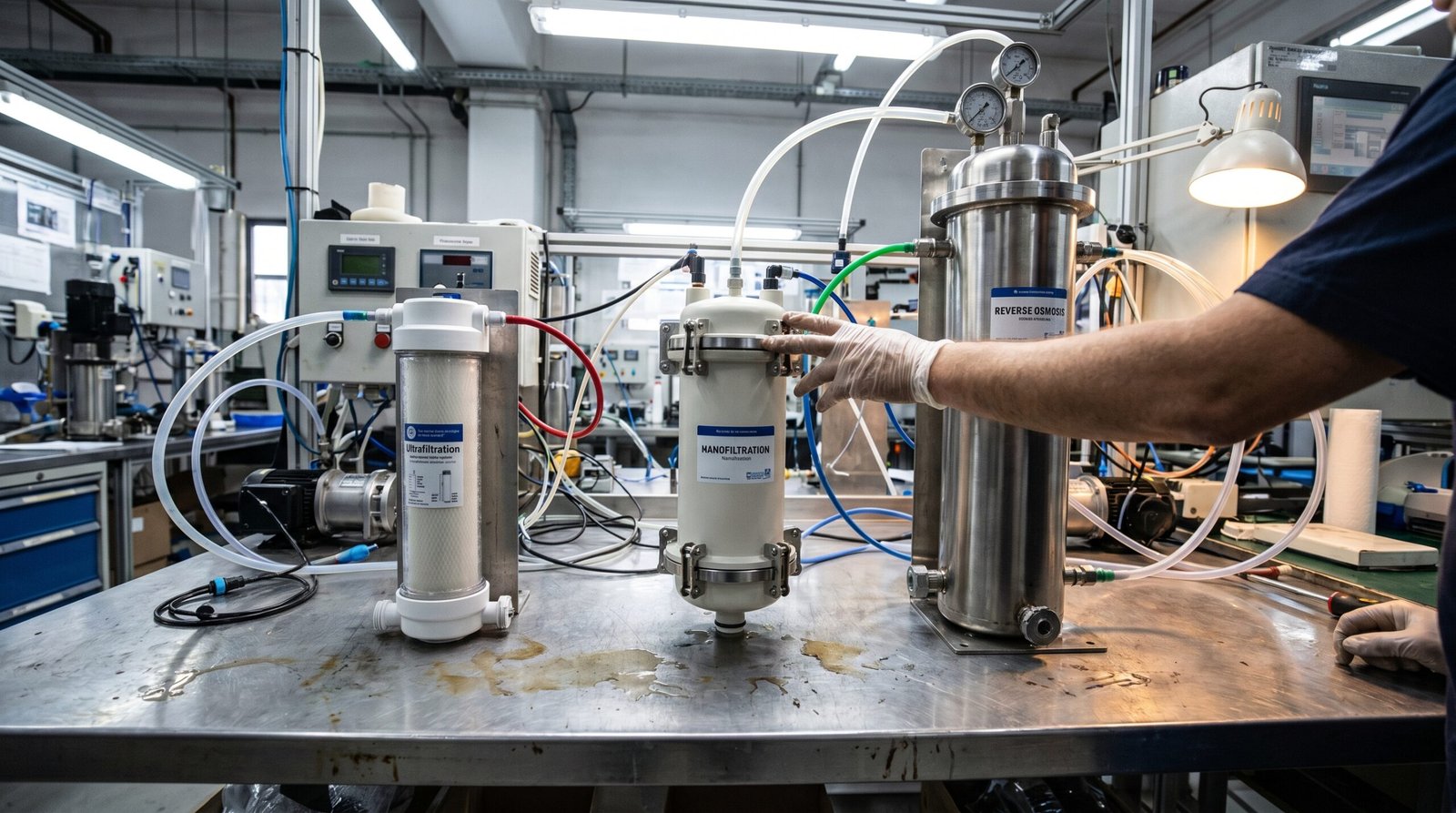
UF, NF, and RO membranes differ by pore size and what they remove. Ultrafiltration (UF, about 0.01 micron) removes bacteria and dirt but keeps minerals. Nanofiltration (NF, about 0.001 micron) removes hardness and most salts. Reverse osmosis (RO, 0.0001 micron) removes almost everything, including dissolved salts, at 99.99% sterilization.
The differences matter for your business, not just the lab. Here is what each one means for what you stock and sell.
UF vs NF vs RO Membranes: What Does Each Remove from Water?
I have seen distributors lose money by selling the wrong membrane for the local water. A customer with hard, salty water buys a UF system, then complains it tastes the same. The membrane was never built for that job.
UF removes bacteria, viruses, dirt, and cloudiness, but leaves dissolved salts and minerals in the water. NF removes hardness, color, and most salts while keeping some minerals. RO removes almost all dissolved solids, heavy metals, and germs, giving the cleanest water with the lowest TDS.
Water has two kinds of problems. One is stuff you can filter out by size, like sand, rust, and germs. The other is stuff dissolved in the water, like salt, calcium, and metals. The big difference between UF, NF, and RO is how small a particle each one can catch. Smaller pores catch more, but they also cost more to run. For you, this is the line between a cheap product and a premium one.
UF: clean, safe water that keeps minerals
UF membranes have pores around 0.01 micron. That is small enough to block bacteria, viruses, mud, and rust. But it is too big to stop dissolved salts. So the water comes out clear and safe to drink, but the taste and the TDS stay close to the source water. This is a strong, low-cost option in markets where the main problem is dirty or unsafe water, not salty water. Many of your budget customers will be happy with it.
NF: softening without stripping everything
NF sits in the middle, with pores near 0.001 micron. It removes hardness (calcium and magnesium), color, and a large share of salts. It still lets some minerals through. Buyers like NF where hard water ruins kettles and skin, but the water is not too salty. It is a smart middle-tier product for your price ladder.
RO: the lowest TDS for tough water
RO uses a 0.0001-micron membrane and removes almost everything — salts, heavy metals, fluoride, and germs — with 99.99% sterilization. This is the answer for high-TDS, brackish, or coastal water common across the Middle East and many coastal cities. We add optional strontium-rich alkaline remineralization so the water tastes good after RO. Because RO works the dissolved solids so hard, you can sell it as the top product in your range, with the highest ticket price.
| What is in the water | UF | NF | RO |
|---|---|---|---|
| Bacteria and viruses | Yes | Yes | Yes |
| Mud, rust, cloudiness | Yes | Yes | Yes |
| Hardness (calcium, magnesium) | No | Mostly | Yes |
| Dissolved salts / TDS | No | Partly | Yes (95–99%+) |
| Heavy metals | Low | Some | Yes |
| Keeps natural minerals? | Yes | Some | No (add remineralization) |
Which Membrane Uses the Least Energy and Pressure?
I get this question from distributors who sell in places with weak power and high electricity bills. Their customers ask about running costs before they buy. If you cannot answer, you lose the sale. Energy use starts with the membrane.
UF uses the least energy and pressure, running at about 1–3 bar. NF needs medium pressure, around 3–10 bar. RO needs the most, from about 6–15 bar for normal water and far higher for seawater. Lower pressure means lower power bills and simpler pumps for your customers.
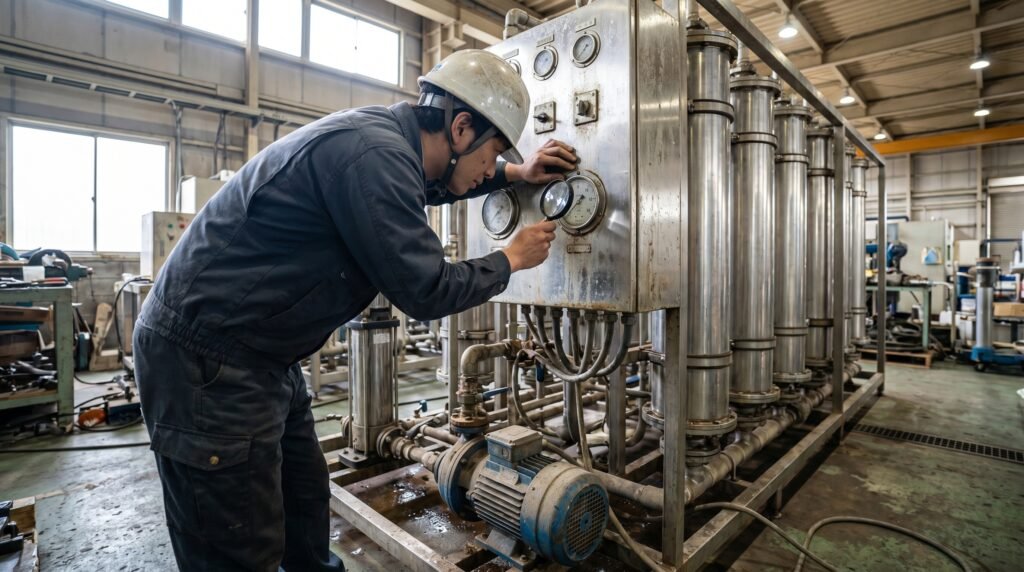
Smaller pores need more push. To force water through a tighter membrane, you need a stronger pump and more power. That is why UF is cheap to run and RO costs more. For your customers, this shows up on the electricity bill every month. It also decides which pump and parts they need to buy from you later.
Why low pressure helps you sell
In many markets across Africa and South Asia, power is costly or unstable. A UF system that runs at 1–3 bar can even work on tap pressure in some homes. That makes it easy to install and cheap to run. You can use this as a clear selling point: lower bills, fewer pump problems, less service. Low running cost is an easy story for your sales team to tell.
When higher pressure is worth it
RO needs more pressure, so it uses more power. But for salty or coastal water, there is no other choice. The value is clean, drinkable water where nothing else works. You can sell RO as the premium product and explain the higher running cost as the price of safe water. Our seawater desalination systems handle up to 2 T/h for refill stations and resorts near the coast.
Smart features cut waste
Power is not the only cost. Wasted water costs money too. Our RO systems use a zero-wastewater design, so your customers do not pour money down the drain. The smart IoT module tracks TDS and filter life through an app, so customers replace parts on time. That keeps the system working well and brings you repeat spare-part orders.
| Membrane | Pore size (micron) | Typical pressure (bar) | Relative energy use | Best power setting |
|---|---|---|---|---|
| UF | ~0.01 | 1–3 | Low | Weak or unstable grids |
| NF | ~0.001 | 3–10 | Medium | Stable grids, hard water |
| RO (brackish) | 0.0001 | 6–15 | High | Salty or high-TDS water |
| RO (seawater) | 0.0001 | 50–80 | Highest | Coastal / desalination |
Can UF, NF, and RO Be Combined Together?
Some distributors think they must pick only one membrane. Then a customer wants clean, great-tasting water, and they feel stuck. You do not have to choose just one. The best systems often use more than one stage.
Yes, UF, NF, and RO can be combined in one multi-stage system. A common setup uses sediment and carbon filters first, then UF or RO, then UV and remineralization. Our 8-stage RO systems do exactly this. Combining stages gives cleaner, better-tasting water and longer membrane life.
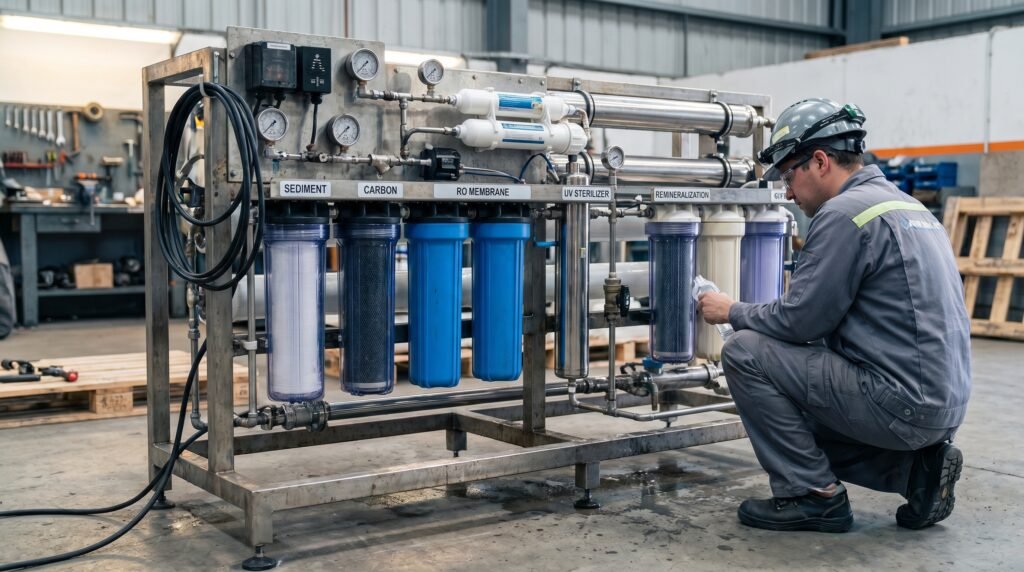
One membrane rarely does the whole job alone. Each stage has a role. Sediment and carbon filters protect the main membrane from dirt and chlorine, so it lasts longer. The main membrane (UF or RO) does the deep cleaning. UV adds a final safety step. Remineralization fixes the taste after RO. Put together, the stages cover every problem in one box.
How a multi-stage system works
Our 8-stage RO design is a good example. Water flows through pre-filters, then the 0.0001-micron RO membrane, then continuous UV sterilization, then optional strontium-rich alkaline remineralization. The result is water at 99.99% sterilization that still tastes good. For your customer, that means safe water and no flat, “empty” taste. For you, it means a complete product you can sell with confidence.
Why combined systems are good for your margins
A multi-stage system has more parts that need changing. That sounds like a downside, but it is the opposite for a distributor. Every filter and membrane is a future sale. When you stock the matching spare parts, you build steady repeat income long after the first unit ships. The smart app reminds customers when each part is due, so they come back to you on time.
One factory, many configurations
You do not need three suppliers for three membrane types. We make 200+ models across UF, NF, and RO, all under one roof in our 50,000 m² factory. You can mix your order, keep your MOQ low, and still get one shipment, one invoice, and one set of papers. That cuts your freight cost and your paperwork.
| Setup | Main stages | Best for | Sell it as |
|---|---|---|---|
| UF + UV | Pre-filter, UF, UV | Unsafe but low-salt water | Entry / budget line |
| NF + carbon | Pre-filter, NF, carbon | Hard water, color, taste | Mid-tier line |
| 8-stage RO | Pre-filter, RO, UV, remineralization | High-TDS, salty, coastal | Premium line |
How Do You Choose the Right Membrane for Your Application?
Choosing a membrane is a business choice, not just a tech one. I have watched distributors guess, stock the wrong models, and tie up cash in dead inventory. The right pick depends on your local water and your customers’ budgets.
To choose the right membrane, start with your local water and your buyers. Use UF for unsafe but low-salt water and budget customers. Use NF for hard water that needs softening. Use RO for high-TDS, brackish, or coastal water. Match the membrane to TDS, power, and price.
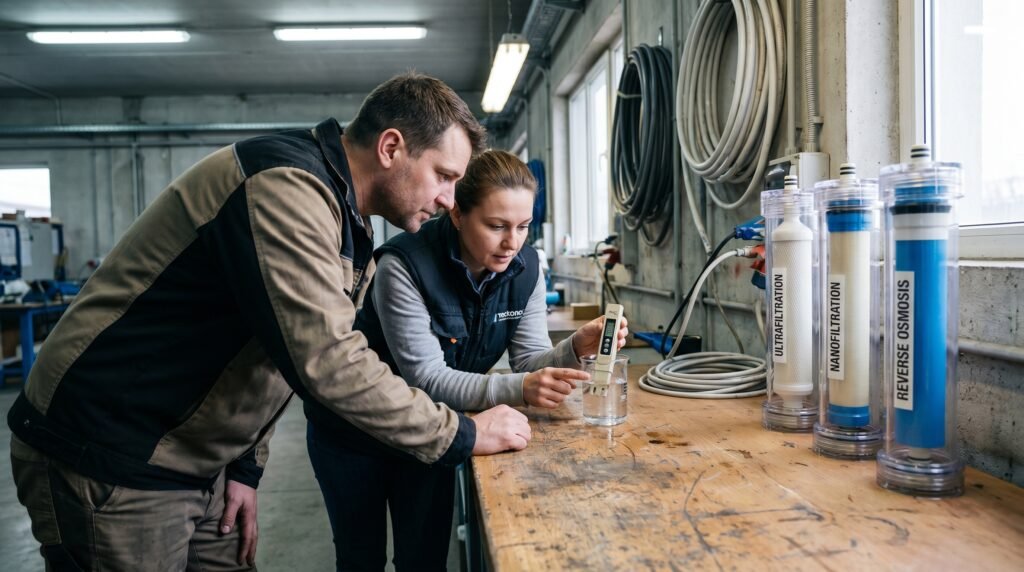
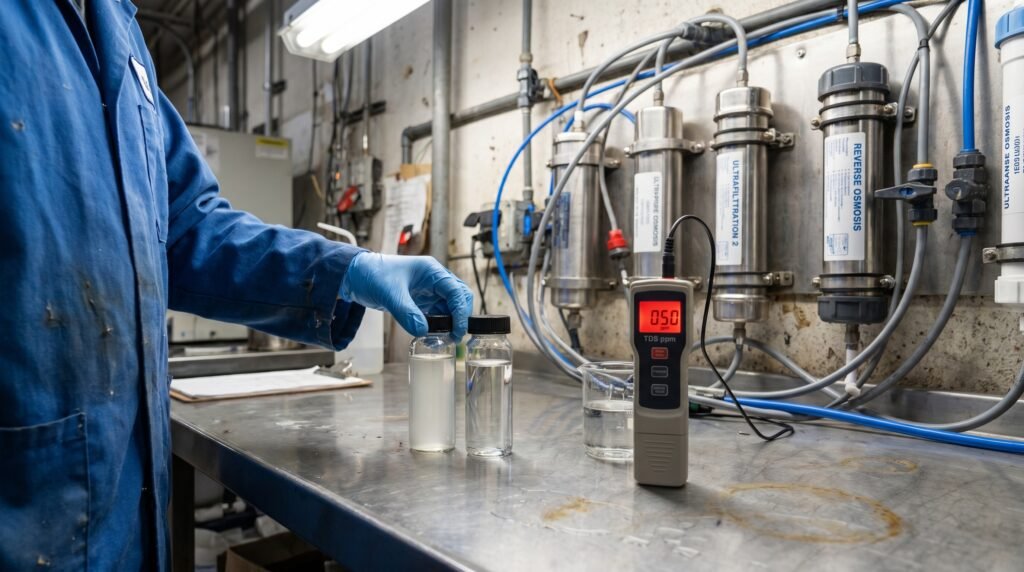
Start with one number: the TDS of your local water. TDS means total dissolved solids — how much salt and mineral is in the water. A cheap TDS meter gives you the answer in seconds. Low TDS with germ problems points to UF. Hard water points to NF. High TDS, brackish, or coastal water points to RO. This one test stops most stocking mistakes.
Match the membrane to your market
Think about who buys from you. Homes on a tight budget want a low price and low bills, so UF fits. Families in hard-water areas want soft water and better taste, so NF fits. Hotels, schools, and refill stations near the coast need the lowest TDS, so RO fits. When you stock the right mix, your shelves move faster and your cash is not stuck.
Do not forget papers and after-sales
Local certification can block a sale or even a whole shipment. We hold CE, SASO, BIS, INMETRO, NOM, KC, PSE, ESMA, and more, with compliance support for 30+ markets. That helps you clear customs and win tenders. Every unit also carries a 2-year warranty, and we run third-party inspection (SGS, BV, TÜV) before shipment, so you get fewer faulty units and fewer claims.
Start small, then scale
You do not need a huge first order to test a model. Distributor samples start from 10 pcs, so you can trial UF, NF, and RO in your market before you commit. We have shipped 2,000,000+ units to 45 countries and serve 500+ B2B partners, so you are buying from a proven export factory, not a guess. During production, you get daily photo and video updates, so you always know where your order stands.
| Your local water | Customer type | Best membrane | Why it sells |
|---|---|---|---|
| Low TDS, germs | Budget homes | UF | Cheap to buy and run |
| Hard, high mineral | Hard-water areas | NF | Soft water, better taste |
| High TDS / brackish | Mixed, growing demand | RO | Only real fix, premium price |
| Seawater / coastal | Hotels, refill stations | RO (seawater) | Clean water where nothing else works |
Conclusion
UF, NF, and RO each fit a different water problem and a different customer. Match the membrane to your local TDS and budget, then stock the right mix. Want help? Get a free quote from our team today.